

Introduction
Costume Design is a very important factor when it comes to portraying an emotion according to a situation in the film. Costume design tells a story in a scene. If a person is in rags, they are poor. If a character is in armor, they are in the military. Each costume tells a story about a person without having to say a word. What transcends Gladiator’s costume design to the top of its class is the detailing. Gladiator has a lot of unique scenes to really show off their multiple, intricate designs and ideas behind the costumes. They have opportunities to dress warrior, gladiators, emperors, children, politicians, and barbarians. From the opening fight scene in Germania to the final battle between Maximus and Commodus in the Colosseum. I think Gladiator nailed it in their costume design and did a great job. Gladiator has the best costume design when trying to depict an emotion within a scene. I feel this way because of the detailing in the design. Also, in how it complements each scene and what is it is trying to portray to the audience.
This essay will be formatted in a way of scene analysis. It will be formatted in this way to show examples of how the costume designers made an outfit to compliment the scene being analyzed. The costume design will also be analyzed in how each costume gives non-verbal and symbolic ques to the audience to portray a character’s status, as well if there is an emotion, we are supposed to experience how that design creates that feeling. There is also an aspect of character progression signaled to us through costume. The most obvious transformation is seen in Maximus.
Symbolic and non-verbal ques in Maximus
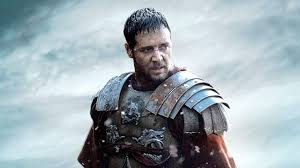
Maximus comes to us first as a Roman general, ready for battle. He is outfitted with a big silver chest plate, with silver embroideries. There is an undershirt that is red like that of the Roman military. His outfit works accordingly to his status and delivers a clear message to the audience that he is someone important.
When Maximus is on his journey to save his family after escaping the praetorian guard, his outfit changes as he gets further and further away from Rome and his Roman army. When Maximus first leaves he is in full armor and it shows about three or four different scenes. Each scene he loses a piece of his Roman attire. As Maximus arrives on his property he is left with nothing but a t-shirt. I saw this as symbolism, as the further Maximus gets further away from his army and from Rome. His status changes from Roman General into a person with no title or status in the world. We see this symbolism reinforced as he abandons his name and adopts the name, Spaniard.
We see Maximus next in Northern Africa as a gladiator. He is bought by Proximo, where he is valued as a body to be killed for a show in his arena. Proximo sees no value in Maximus and therefore we see Maximus in no armor and only a t-shirt. The nonverbal cue takes place when Proximo begins to see value in Maximus. Proximo sees Maximus as his way back to the colosseum and to relive his former glory as a gladiator through Maximus. Therefore, the next time we see Maximus step foot in the arena, he is in a full armored breastplate. We see Maximus in this same breastplate for the remainder of the action scenes in the movie. The next scene where we see the contrast in the final action scene of the movie where Maximus and Commodus duel.
First fight in Northern Africa Last fight in Northern Africa
In the climactic duel between Maximus and Commodus, we see a lot of contrast. It is fitting to see the contrast between these characters because Maximus is our main protagonist and Commodus is our main Antagonist. However, Commodus is wearing an all-white outfit and Maximus is in the black outfit. Normally, characters in the white costumes are our Christ-like figure throughout many films. Personally, this made me question why Commodus was in the white because he has been so evil through-out the film and It did not quite make sense to me. Commodus, as a character puts a lot of value in what people think of him and in materialistic possessions. Commodus arrives on the scene to embody these values. He wants people to think he is Rome’s savior and is the Christ-like figure they need. From beginning to end we always see Commodus in the grandest outfits. Always wearing clothes and colors that embody Roman royalty. These reasons are why Commodus is wearing white instead of Maximus. Maximus fights in this scene in the same black breastplate that he wore in North Africa. Maximus’s breastplate symbolizes his motivations. He had two horses on his breastplate, and he said that they used to be two horses he owned. This is important because it is symbolizing one of the last pieces of his home he has. It is in black because I believe it shows that Maximus does not place value in looking the part, he holds value in a moral code. The moral code he abides by is one of family, honor, duty, and strength. In Maximus’s tragedy of what happened to his family and to his life, a new value comes into play which is one of vengeance. The main value shown through his armor is the values of family and vengeance. Family is seen with the horse on his chest and vengeance is portrayed in the black color of the armor. In a way, I think he is being portrayed as a figure of death, specifically to Commodus. This another reason why the contrast between black and white is prevalent in this scene. I also think it is important to notice the linearity of Maximus’s costumes, focusing on his breastplate. It shows that even when he is facing the man that ruined his life and murdered his family. Maximus holds on tight to his values.
I find it very interesting that we can understand most of these symbolic and non-verbal through costume design. They are more than just a piece of cloth to wear, they tell so much more. They communicate with the audience in a deeper way than just dialogue. They tell what the motivations and characteristics of each character are without much verbal description.
Watch from 2:50 to 4:50 to see how Maximus changes his apparel


Outfit for the opening battle against the barbarians
You can watch the whole scene if you want but really focus on the contrasting value of Marcus's and Commodus's outfit.
Military costumes
What is worn. Why were these costumes chosen?
The Praetorian guard serves as the Emperor's personal guards in Roman culture. In Gladiator they are depicted in a more antagonistic way. They are the ones who were sent into the woods to execute Maximus and the praetorian guard are the ones who surround Maximus in the colosseum when he is trying to exit. Their costumes are black with some gold trim and have a purple undergarment. Purple is a very prevalent color through this film because it is commonly used to symbolize royalty. The Praetorian guard's costume is a very aesthetic design and is the only outfit we see them in.
.jpg)

I did notice another symbolic choice made by the designer and maker of this film. The symbolism in the praetorian costume design is in the final scene where Maximus and Commodus are fighting. Maximus is wearing black and Commodus is wearing white as we discussed before. It came to my attention that the praetorian guard is also wearing black, complimenting Maximus. In this scene, it seems that Commodus is the only one out of place. Everyone on the Colosseum floor is in black, except for Commodus. It demonstrates a shift in the power dynamic of the praetorian guard. Maximus is supposed to be the lone gladiator surround by the emperor’s men, while in fact, it seems that Commodus is the lone man in the fight. Evidence of this shift is when Commodus cries out for a sword, but as he is shouting out the praetorians, they do not give into Commodus’s demand. This is another example of how costume design can give off non-verbal cues to the audience without having to say a word. It just goes to show how important costume design is in film making.

There is one chapter in Gladiator that portrays a large military fight scene. This is in the opening of the film with the Romans and the Germanian barbarians. In this scene, the Romans are outfitted in armor that is a lot less substantial to the kind of armor we see in other fight scenes. The costume designer made sure to give the Roman soldiers a red undergarment to clearly mark that they are a part of the Roman forces. The Romans are representing order and an element of uniformity. Even though the costumes are simplistic they get the point across to the audience of what they are supposed to represent. The Roman soldier’s costumes lack detailing most likely because of the insignificant impact the soldiers have on the story of the film. However, on the other side of the battlegrounds, the Barbarians are dressed in dark, black clothing. As well as dark fur to further portray how they are wild and unorthodox. Their costumes show this by having no common uniform across the soldiers in their forces. The dark clothing and lack of colors are present to show that they do not follow one particular ruler and are more so, normal people, rather than soldiers. Costumes can sometimes be connected to complex thoughts and themes, but this cannot always be the case. This military scene is an example of how costume designs can be more simplistic and to portray simple ideas.
This video is to show the costume used in the fight scene as well as how it complements their traits spoken about above